
Pahrump Previous Residents: Time Sources
Previous residents of a Pahrump address leave uneven trails. Recorded documents can identify parties to land transactions, but they do not prove that either party lived at the property. An assessment parcel helps maintain the property identity across documents. Local telephone artifacts, census material, oral histories, photographs, and museum files can add dated household context. Because Pahrump is an unincorporated town within Nye County, a Pahrump question can also lead to county sources in Tonopah. Begin with the source closest to the time period, then preserve the distinction between an owner, a subscriber, a narrator, and a resident.
| Source | Years it covers | Where held | What it can show |
|---|---|---|---|
| Recorder online index | Previous day back to 1986 | Nye County Recorder portal | Recorded-document index entries and document locating details |
| Earlier Recorder material | Before 1986 | Recorder, including Tonopah contact route | Older record access after office assistance |
| Pahrump telephone artifacts | March 1964 and March 6, 1965 documented | Nye County History Project and UNLV context | Dated subscriber leads, not a current address crosswalk |
| Census material | 1870 through 1940 reported by the history project | Nye County History Project discovery route | Historical household and locality research |
| Photos and oral histories | Pahrump photo subseries, 1910 through 1990 | UNLV and local repositories | Community, family, ranch, school, and place context |
Start near the present with the parcel and Recorder trail. Move to the older sources only when the date fits. No confirmed official Pahrump city-directory, reverse-directory, criss-cross-directory, or Sanborn series was located in the research, so those labels should not be assumed for an address history.
The Nye County Recorder disclaimer frames the first source as an index rather than the instrument itself.
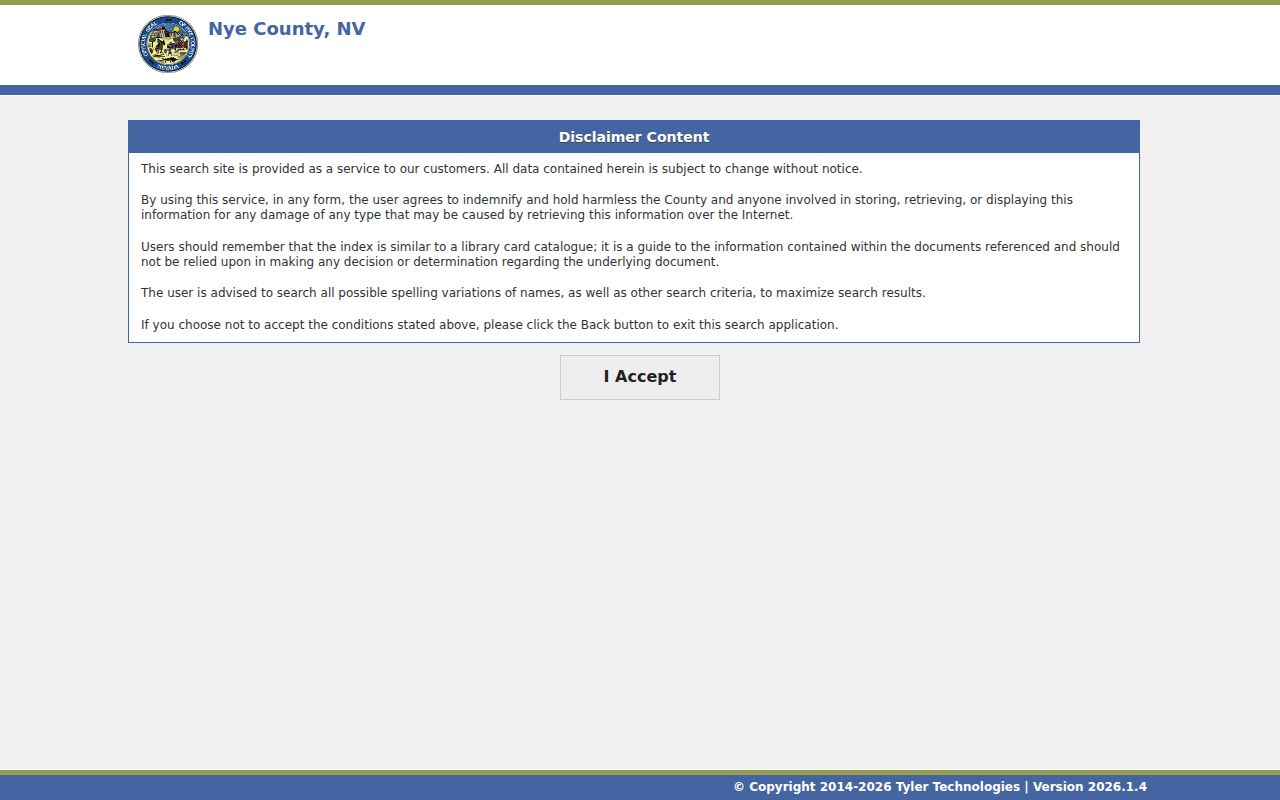
An index entry can locate a recorded document, but its party names and return-address details must be verified against the underlying record.
Pahrump Previous Residents: Begin With Parcel
For a Pahrump address history, the Nye County Assessor Property Inquiry can supply the parcel connection needed for an orderly search. The portal accepts an eight-digit parcel ID without dashes, plus owner-name, house-number range, street, city, and ZIP searching. Copy the parcel ID, legal description, and date viewed before comparing any Recorder result. A mailing address can differ from a situs address, and an assessor owner field is an assessment record, not proof of occupancy or a complete history of past residents.
GIS adds a check on parcels, streets, boundaries, and adjacent mapped context. The official Nye County Planning FeatureServer includes Addresses, Streets, Parcels, and boundary layers. It can help preserve an address’s geography when a historical source uses a subdivision or road reference, but a map polygon never substitutes for a recorded instrument or a survey.
Note: Preserve each portal’s displayed parcel format and date, since map PDFs and web search tools can present identifiers differently.
Pahrump Previous Residents: Deed Chain
The Recorder trail is a backward chain of recorded transactions, not a list of who lived at an address. A grantor is a party transferring an interest. A grantee is the party receiving an interest. The chain of title is the sequence of instruments that connects earlier transactions to later ones. A legal description identifies land in the recording system and often remains more reliable than an old street form. Those distinctions are central when research turns from a present parcel to prior recorded parties.
- Use the current assessment parcel and legal description to identify the property being researched.
- Open the Nye County Recorder search and locate a recent document by the available party or document details.
- Record the document number or Book/Page, recording date, document type, and the named parties before requesting or reviewing the instrument.
- Follow the earlier party and legal description through the next relevant recorded instrument, keeping uncertain matches separate.
- For material before the portal’s online range, contact the Recorder’s Tonopah office rather than filling the gap with a presumed address match.
- Grantor
- The party who transfers an interest in a recorded document.
- Grantee
- The party who receives an interest in that document.
- Chain of title
- A dated sequence of recorded instruments affecting the same property.
- Legal description
- The land description used in recorded documents, often more stable than a street-address label.
The Recorder’s Pahrump office is at 170 N Floyd Street, Suite 1, with 775-751-6340 listed. The copy-request instructions say a mail request should include the document number or Book/Page, page count, and fee. Phone, in-person, mail, registered access, and a focused public-record request are separate routes when the public index is not enough.
Pahrump Previous Residents Before 1986
The online Recorder index is advertised from the previous day back to 1986, and document images are added daily. Earlier Pahrump research therefore has a geographic handoff to the Recorder’s Tonopah office. Nye County’s seat moved to Tonopah in 1905, while Pahrump is the county’s large southern unincorporated community. That history helps explain why an address question can require a call, visit, copy request, or archival referral outside the Pahrump counter route.
Public Login is described as recorded-document searching without images. The registered-user route separates image and printing access. Do not treat a visible index hit as an image review, and do not treat a document party as a past resident without another dated source.
The Recorder login page shows the separate Public Login, registered-user, registration, and Fraud Guard paths.
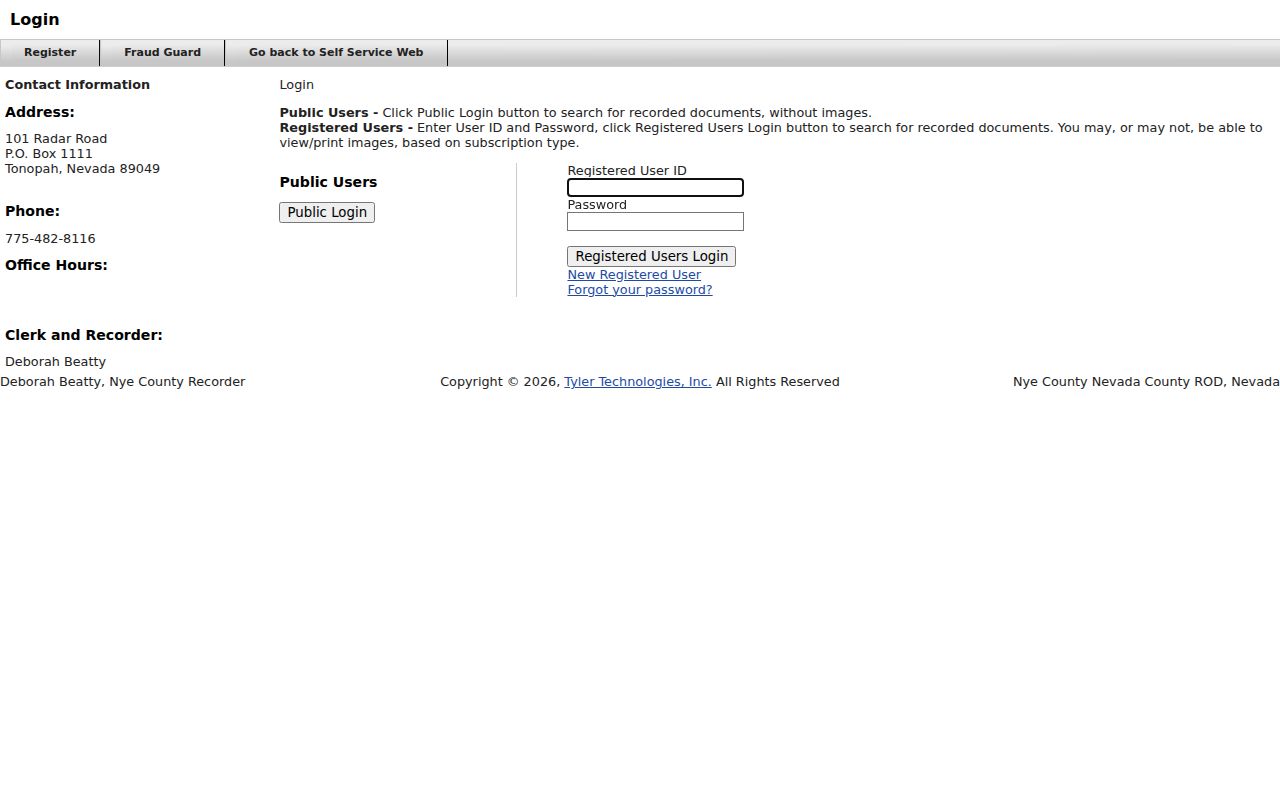
The access choices reinforce the difference between an open index search and any separate image or printing permissions.
Pahrump Previous Residents: Household Clues
Recorded ownership is only one part of a Pahrump previous residents search. The Nye County History Project reports census material from 1870 through 1940, oral histories, documents, photographs, cemeteries, and films. These sources can help build a dated household hypothesis when they identify a family, ranch, school, business, or community institution. They do not create a precise address trail by themselves, especially where the historical source uses a locality, route, or subdivision name rather than a modern street address.
Pair dated records in order: property identity, recording date, historical telephone or community lead, then a census or archival source that matches the era. The aim is to confirm a time-and-place connection from more than one source, not to force a continuous list. The collection-level material is discussed on the Pahrump Directory Book page, while a prior-address inquiry should keep only the household clues that relate to the chosen property and date.
- Write down the parcel, legal description, historic street or subdivision wording, and date range.
- Compare the date range with Recorder coverage and then with the reported local telephone or census sources.
- Ask the repository whether it has a dated, address-relevant item rather than assuming a city or criss-cross directory is available.
- Check the original image, transcription, or finding aid and retain the collection identifier with the research note.
Note: A telephone subscriber, oral-history narrator, and recorded party are distinct roles that should not be collapsed into a claim of residence.
Pahrump Previous Residents: First Phone Trail
Pahrump’s early telephone material is a useful human record of a small community’s growth. An oral-history account says electricity arrived in 1963 and telephone service arrived on March 6, 1965 with 76 subscribers. Local history material records a March 1964 Pahrump telephone directory and describes the March 6, 1965 book as a collector’s item. Those dates make the early phone trail an archival lead for family, ranch, school, and community research. They do not establish that a current street number uses the same form as the older listing.
The Nye County History Project uses oral histories and town-history materials to direct researchers to early local names and institutions.
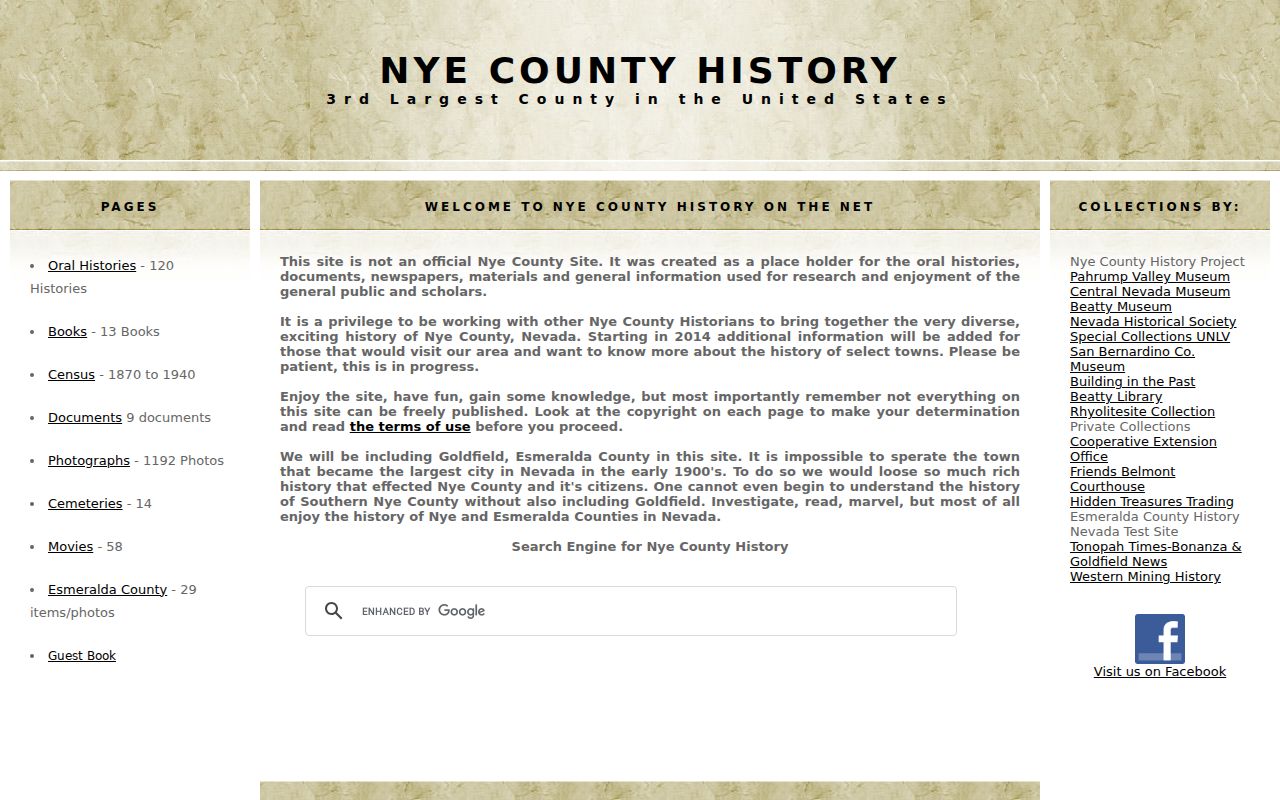
Use the history project as a discovery source, then label oral-history and transcription material according to its original form.
Pahrump Previous Residents: Local Archives
The Pahrump Community Library is a practical local handoff when a documented address trail ends. Its collection emphasis includes Nevada nonfiction and genealogy nonfiction, and the help guide says staff can assist with catalog research. No confirmed online catalog run for Pahrump city directories, reverse directories, or criss-cross directories was found. Ask about uncataloged local-history binders, old telephone books, obituary files, cemetery files, and microform. A request that supplies an address form, date range, and source already checked is more useful than a broad request for every name connected with a place.
The Pahrump Community Library help guide explains its research-help context and public-record request route.
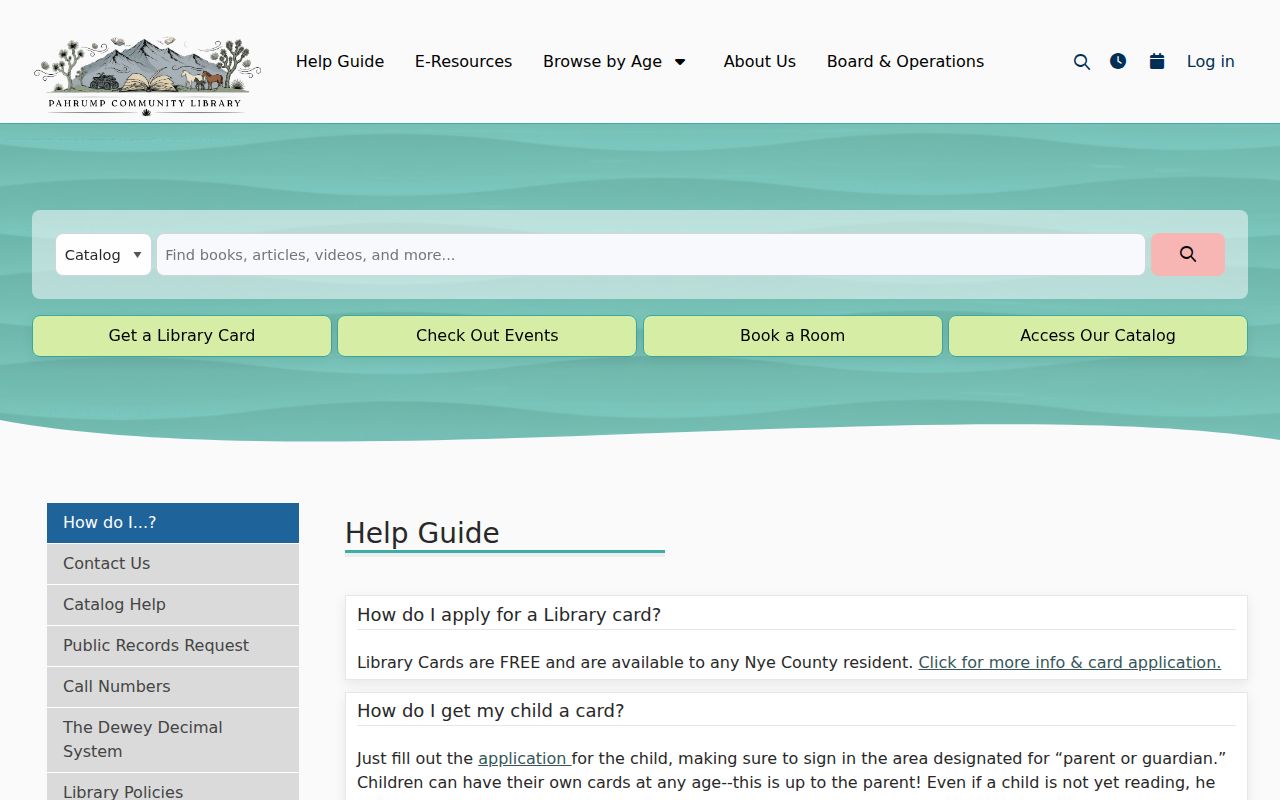
Library staff and local collections can identify whether a historical item exists before a researcher treats a directory reference as a proven holding.
UNLV Special Collections’ Nye County Photograph Collection includes a Pahrump subseries dated 1910 through 1990, with ranches, families, school, store, airstrip, and community-life material.
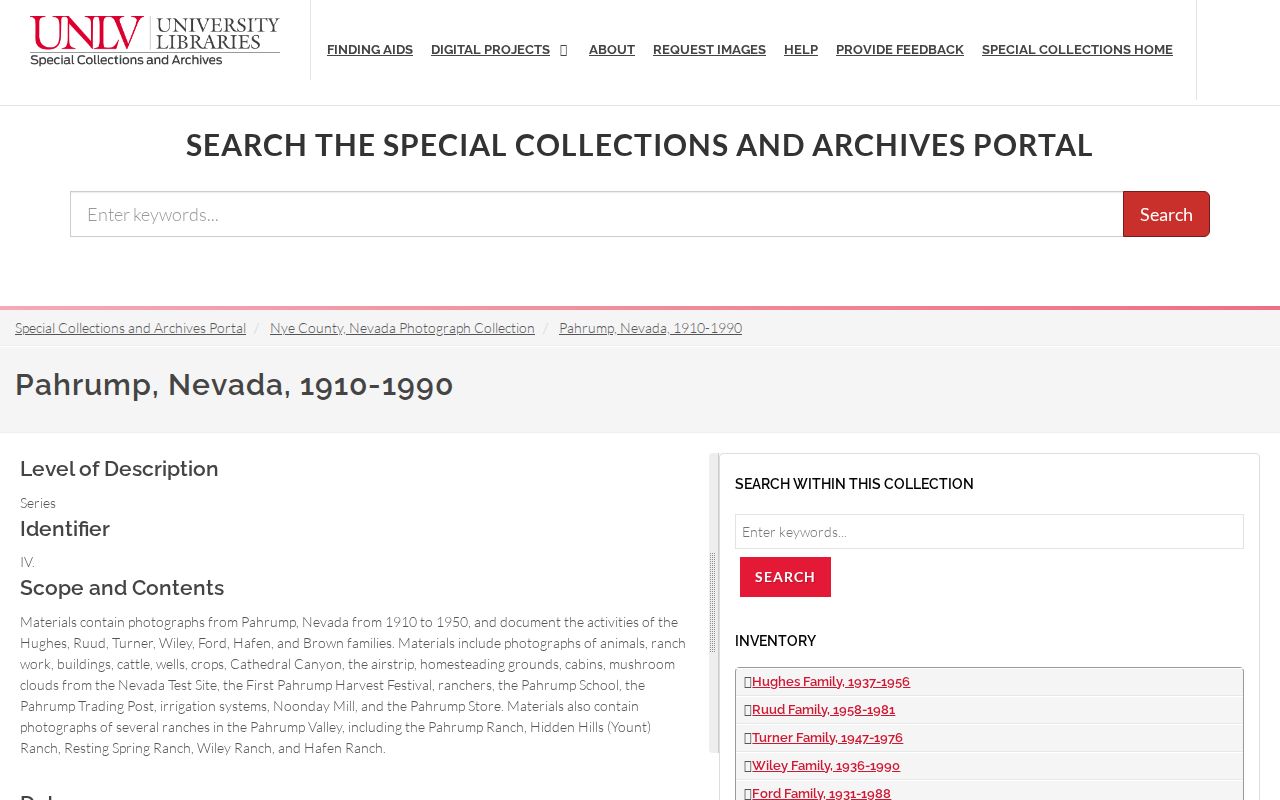
Photographs and finding-aid context can strengthen a place history, but they need a dated caption or collection reference before supporting an address conclusion.
Pahrump Previous Residents: Privacy Limits
Past residents research should be limited to lawful historical, family, estate, civic, or property-context questions. Public records may be stale, partial, or restricted. Nevada protects DMV information, confidential vital records, sensitive voter information, sealed and protected court material, and Confidential Address Program information. Historic sources can also preserve mistakes or use a name shared by several people. Keep the document date, custodian, collection name, and uncertainty with every conclusion.
Lawful use. Pahrump address history is for lawful personal research, not harassment, surveillance, repeated unwanted contact, or attempts to identify a protected location.
The Nevada Confidential Address Program provides substitute-address protections for qualifying participants. Do not use older records or public maps to try to uncover a protected physical address.